

The political landscape in Cobb County took a sharp turn following news of a federal indictment involving the Southern Poverty Law Center (SPLC), an organization that has long positioned itself as a moral authority in national political debates. Now, serious allegations of fraud are raising new questions about the credibility of the group and the candidates it chooses to promote.
According to a press release from the U.S. Department of Justice, the SPLC was indicted by a Federal Grand Jury on 11 counts including wire fraud, false statements, and conspiracy to committed money laundering, alleging it improperly raised millions of dollars that were secretly funneled to leaders of extremist groups, including the Ku Klux Klan.
“The SPLC is manufacturing racism to justify its existence,” said Acting Attorney General Todd Blanche.
“Donors gave their money believing they were supporting the fight against violent extremism,” said Acting United States Attorney Kevin Davidson. “As alleged, the SPLC instead diverted a portion of those funds to benefit individuals and groups they claimed to oppose.”
The Indictment alleges that between 2014 and 2023, the SPLC secretly funneled more than $3 million in donated funds to individuals who were associated with various violent extremist groups including:
- Ku Klux Klan
- United Klans of America
- Unite the Right
- National Alliance
- National Socialist Movement
- Aryan Nations affiliated Sadistic Souls Motorcycle Club
- National Socialist Party of America (American Nazi Party)
- American Front
The SPLC has denied wrongdoing, stating it “will vigorously defend ourselves, our staff, and our work,” and asserting that payments in question were made to informants as part of efforts to infiltrate hate groups and share intelligence with law enforcement.
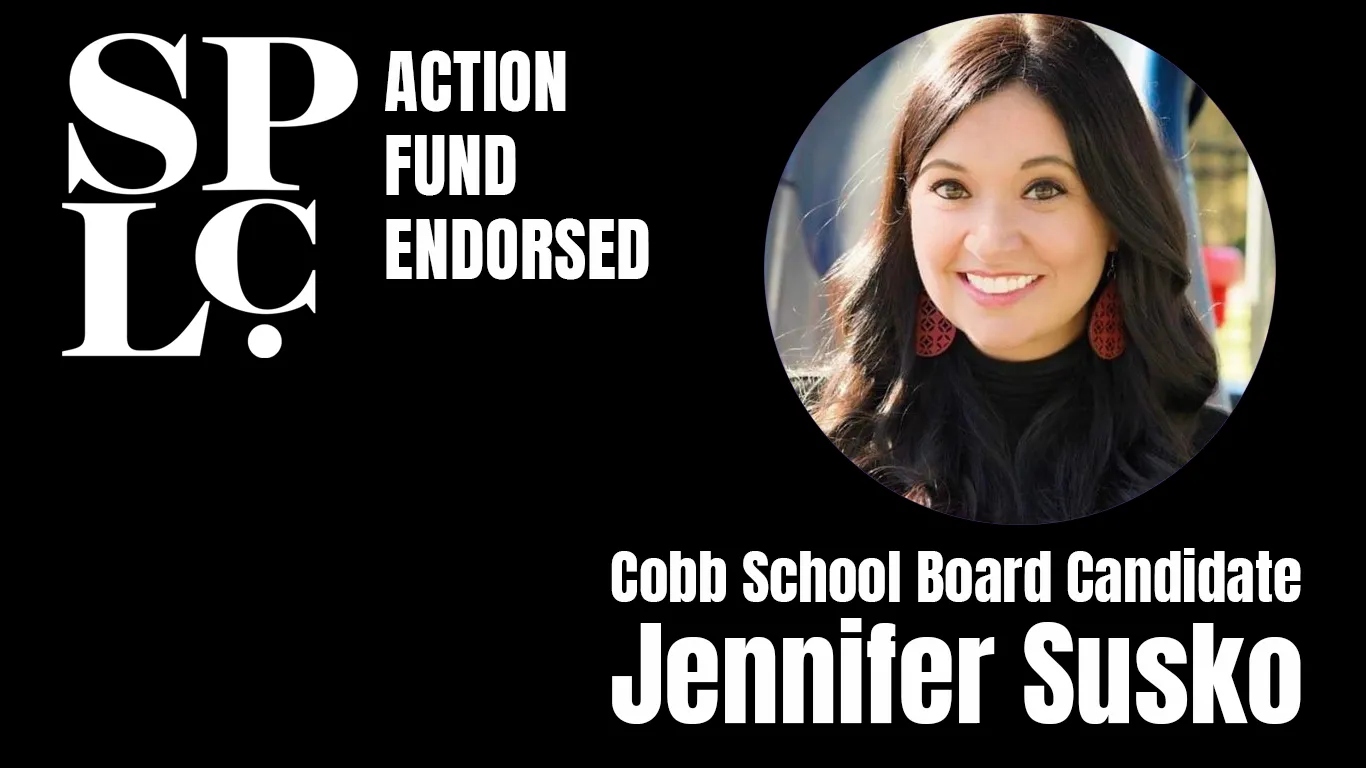
Regardless of the legal outcome, the political fallout is already being felt locally. One of the SPLC Action Fund’s recent endorsees is Jennifer Susko, a Democratic candidate challenging incumbent Post 6 board member Nichelle Davis for a seat on the Cobb County Board of Education.
That endorsement, once touted as a badge of honor in progressive circles, now raises serious concerns. When a national organization under federal indictment inserts itself into a local school board race, voters are right to ask what values and priorities are being imported into Cobb County schools.
A Controversial Endorsement in a Local Race

Jennifer Susko, a Cobb native and former school counselor, reportedly resigned from the Cobb School School District in 2021 in protest after the school board voted to ban critical race theory and The New York Times’ 1619 Project from classroom instruction. At the time, many parents applauded the board’s decision, seeing it as a necessary step to keep political activism out of the classroom and refocus schools on core academics.
The SPLC Action Fund, however, saw Susko as an ally.
In its endorsement, the group praised Susko for being willing to “put her career on the line” and described her as a “tenacious advocate for equitable and inclusive education.” The organization framed her resignation not as a political statement, but as an act of courage in defense of “students of color” and parents whose concerns were allegedly ignored.
Susko has since stated that she did not request the endorsement and that it was given without her knowledge. In response to the indictment, she commented in a MDJ article that she is “awaiting more information before forming an opinion or taking action,” while criticizing what she described as selective prosecution by the current Department of Justice.
But neutrality in the face of serious allegations is unlikely to satisfy many Cobb voters prior to the Gereral Primary election.
When a candidate potentially benefits from the backing of a politically aggressive national organization who allegedly donated to racist hate groups, and is now facing federal indictment charges, questions about alignment naturally follow not to mention the hypocrisy of it all.
The SPLC is no stranger to controversy in Cobb County. The organization has supported multiple lawsuits against the Cobb School District, including legal battles over COVID-19 mask mandates, disciplinary actions, and the firing of a teacher who read a book about gender identity to students. In each case, the SPLC positioned itself against the district’s leadership and, by extension, against many local parents who supported those policies.
Cobb Voters Deserve Transparency and Accountability
The larger issue here is not simply one endorsement. It is about trust, accountability, and the direction of public education in Cobb County.
School board races are often framed community-focused contests. Yet outside organizations with clear ideological agendas continue to exert influence, attempting to reshape local priorities through endorsements, funding, and legal pressure. When those organizations become entangled in serious legal trouble, voters must take a closer look at the networks forming around their local candidates.
The SPLC Action Fund has also endorsed high-profile Georgia Democratic candidates such as U.S. Sen. Jon Ossoff and Georgia Public Service Commission candidate Peter Hubbard. This pattern underscores that the group operates with a broad political strategy, not merely a localized interest in Cobb County schools.
For voters, the question becomes simple: Should a candidate for the Cobb Board of Education be aligned, even indirectly, with a national organization currently defending itself against federal fraud charges?
Democrat Incumbent Nichelle Davis and Superintendent Chris Ragsdale have faced sustained criticism from progressive activists, yet they have also presided over a district that has sought to prioritize parental input, fiscal responsibility, and a focus on academic fundamentals over political trends.
As this story continues to develop, one thing is clear: Cobb County families deserve full transparency from anyone seeking to represent them. Endorsements are not meaningless gestures; they signal shared values and shared priorities.
In the weeks ahead, voters will have the opportunity to decide whether they want their local school board influenced by national activist organizations mired in controversy, or guided by steady leadership grounded in the community itself.
The indictment may ultimately be resolved in court. But in the court of public opinion, the questions are already being asked.