
With the March 2026 special election approaching, campaign finance reports filed with the Federal Election Commission are beginning to clarify which candidates in Georgia’s 14th Congressional District are positioned to compete seriously, and which campaigns may look stronger on paper than they truly are.
Fundraising totals are often cited as a shorthand for viability, but a closer examination of cash on hand and outstanding campaign loans paints a more accurate picture of who actually has money available to spend. In several cases, candidates’ headline fundraising numbers are significantly offset by loans they must eventually repay.
Related Articles: MTG is Gone, Voters Now Choose a New Conservative Voice for Northwest Georgia
The Financial Front-Runner
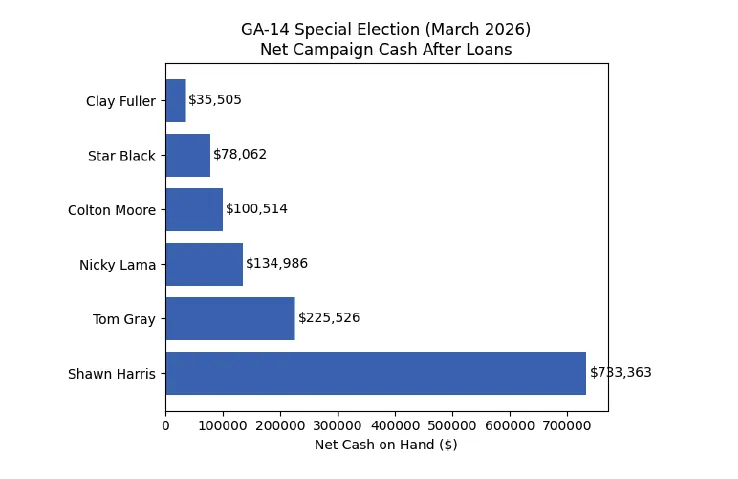
Shawn Harris remains the clear financial leader in the race. His campaign reports more than $733,000 in net cash on hand, even after accounting for all liabilities. Harris has also assembled the broadest donor base in the field, with contributions coming from thousands of individual donors. While Harris’ financial dominance is well established, the more revealing story in the race may be who follows behind him. While Harris has a major advantage in the important fundraising part of a campaign, his Democrat party affiliation is a major hurdle that money can not overcome in this extremely conservative slice of Georgia.
GA-14 Special Election: Campaign Finance Snapshot
Money raised is often cited as a measure of campaign strength, but loans can distort those figures. This explainer focuses on net cash on hand after accounting for outstanding campaign loans.
Tom Gray’s Grassroots Operation Emerges
Second in net cash on hand is Tom Gray, with $225,526 available and no outstanding campaign loans. Gray’s position is notable not only for the amount raised, but for the source of his support.
Unlike several candidates whose fundraising is driven by Republican Party factions or self-financing, Gray’s campaign is largely rooted in grassroots networks built over multiple election cycles. Those include supporters from his previous State Senate race, a loyal audience developed through years on conservative talk radio, and a faith-based network centered in Cobb County with reach across Northwest Georgia.
The absence of campaign debt places Gray in a rare position among the field: every dollar in his account is donor-funded and immediately deployable. That distinction gives Gray flexibility as the race enters its most expensive phase.
The Middle of the Pack
Behind Gray are Nicky Lama, Colton Moore, and Star Black, each maintaining six-figure or near six-figure net balances. Moore, however, has seen his position weaken relative to expectations. Once considered a top-tier contender, Moore’s cash-on-hand figure has slipped, and he now trails both Harris and Gray by a wide margin.
Loan-Driven Fundraising Raises Questions
Perhaps the clearest example of why net cash matters more than total raised is Clay Fuller. While Fuller’s campaign reports more than a quarter-million dollars raised, FEC filings and supplemental reporting indicate approximately $200,000 of that total is personal loans to his campaign. After accounting for those obligations, Fuller’s net usable cash stands at just $35,505, placing him last among the top six candidates by money on hand. While inside sources tell the CobbVoice.com that some of house leadership has decided to back Clay Fuller this can be a double edge sword for a district who’s conservative voters has clearly shown a willingness ignore the outsider’s views.
The disparity underscores a central reality of the race: fundraising totals can be misleading when campaigns rely heavily on loans, particularly as repayment obligations loom.
Why It Matters
In a crowded special election with unpredictable turnout and the possibility of a runoff, financial endurance and real spending power matter more than raw fundraising headlines. Advertising, field operations, and voter outreach all depend on cash that campaigns can actually use.
While Shawn Harris remains the dominant financial force, the latest reports suggest Tom Gray has emerged as the strongest loan-free, grassroots-funded alternative in the field, positioning himself as a candidate to watch as the race moves toward Election Day.